Facing a room that feels unfinished and unsure where to begin? Interior design basics for beginners follow a sequence: set a budget, gather images, choose a focal point, plan the layout, then layer color and light.
- Start with limits. Decide the budget before you look at furniture, so every later choice has a target.
- Collect before you commit. Gather inspiration images straight away and look for repeating colors, textures and shapes.
- Plan on paper first. Test the layout with a scaled plan or painter’s tape before buying anything large.
- Finish with color and light. A consistent palette and layered lighting tie a room together once the furniture is settled.
This guide is organized by what you are trying to do, so you can jump to the route that matches your room. If you want the theory behind the choices, the principles of interior design explain balance, rhythm and contrast in more depth, and how to find your interior design style helps if you cannot yet name what you like.
Choose your route through the basics
Most beginners get stuck because they start with the most visible decision, usually paint or a sofa, instead of the one that constrains everything else. The routes below put the decisions in the order that keeps later choices cheap and reversible.
- Starting a room from nothing: read the sections on starting a room, mood boards and focal points, then move to layout.
- Furniture does not fit or feel right: go straight to the layout section, which covers balance, scale, painter’s tape and thirds.
- The room feels flat or mismatched: go to color palette and lighting, where consistency and layering do most of the work.
- You cannot decide on a look: read the styles section, then follow the room-by-room guides that match your leaning.
Whichever route you take, the decisions interact. A palette that looks right in daylight can change once lighting is layered, and a layout that works on paper can fail once scale is judged in the real room. That is why the sequence matters more than any single rule.
Starting a room: the first decisions
Start designing a room by fixing four practical factors: aesthetics, ergonomics, lifestyle and budget. Design Cafe lists exactly these four as the main factors that affect interior design, and they work as a checklist for any room.
Set the budget first
A sponsored beginner’s guide in The Seattle Times makes the case that a budget set at the start of a project gives you a clear target to work toward. The practical value is in how it focuses priorities: when the total is known, you can decide which items deserve the money (usually the pieces used daily) and which can be modest. Setting it later means you tend to discover the limit only after the best choices are already spent.
Read the four factors against your room
- Aesthetics: the look you want, expressed through color, texture, materials and style.
- Ergonomics: how comfortably the room works for the body, such as seating you can sit in for long periods and surfaces at usable positions.
- Lifestyle: who uses the room and for what. A room used for work, sleep or entertaining needs different things, and a beautiful plan that ignores habits will be fought daily.
- Budget: the limit that decides how many of the first three you can fully satisfy.
When the factors pull against each other, resolve the conflict in favor of lifestyle and ergonomics first, since those are the hardest to fix after purchase, and let aesthetics be adjusted afterwards through color and accessories.
Use your own home as practice
The National Design Academy suggests that beginners redecorate their own home as a design challenge, as long as they go through the full process as they would for a client. That means a brief, inspiration, a plan and a budget rather than impulse buying. Treat your room as a project with stages and the individual decisions below become easier to sequence.
Mood boards and gathering inspiration
A mood board is a place to collect inspiration before you spend money. The National Design Academy describes a visual diary as a scrapbook that creatives use to record everything related to design inspiration, and a mood board is the same idea focused on a single room.
In the Seattle Times guide, Kirk suggests gathering inspirational images right away. Doing it early has a practical benefit: you see what you actually keep choosing before you commit to a direction.
How to read your own board
Collect more images than you need, then look for repetition. If most of your saved rooms share a dominant color, a material such as wood or metal, or a kind of lighting, that pattern is your real preference, even if it differs from the style name you would have chosen. Remove the outliers rather than trying to reconcile them. A board that suggests a single direction is more useful than a broad one that supports every option.
Carry the board into shops and paint aisles. It is the quickest test for whether a new item belongs in the room, because anything that does not echo a color, texture or shape on the board is a candidate to leave behind.
Choosing a focal point
Every room needs a clear emphasis, and a room is usually designed around a focal point. Decorilla states the first point and Design Cafe the second, which makes the focal point a sensible early decision: it decides where furniture faces and where the eye should land.
What can serve as the focal point
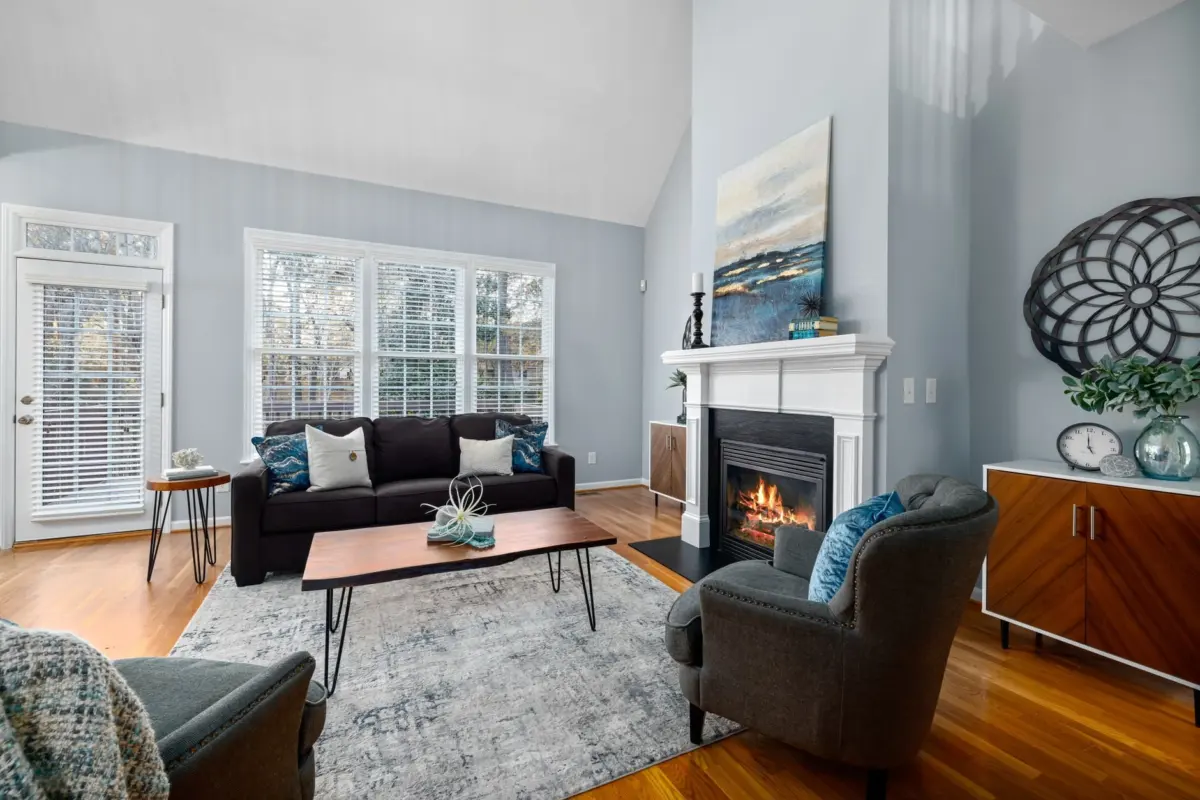
A focal point does not have to be a single object. Decorilla’s example is a captivating setup arranged around a fireplace, which shows that a grouping of furniture, art and lighting can do the job as well as one striking piece. If the room has a natural feature, such as a fireplace, build around it. If it has none, choose something you can create: a large piece of art, a bold sofa or a statement light.
Keep it to one
The guidance is for a clear emphasis in each room, not several competing ones. When you are tempted to add another bold item, ask whether it supports the focal point or competes with it. Supporting items repeat its color or material at a quieter volume; competing items demand attention of their own. Leaving some space unoccupied helps, too: Decorilla notes that allowing some areas to remain unoccupied frames the pieces you chose and prevents overstuffing.
Planning the room layout
Plan a furniture layout by testing arrangements on a scaled floor plan or with tape on the floor before buying. Designers usually use scaled floor plans to see which elements would work for a space, according to Design Cafe, and the method suits a beginner just as well. For a fuller walkthrough, see how to plan a room layout.
Balance: symmetrical, asymmetrical or radial
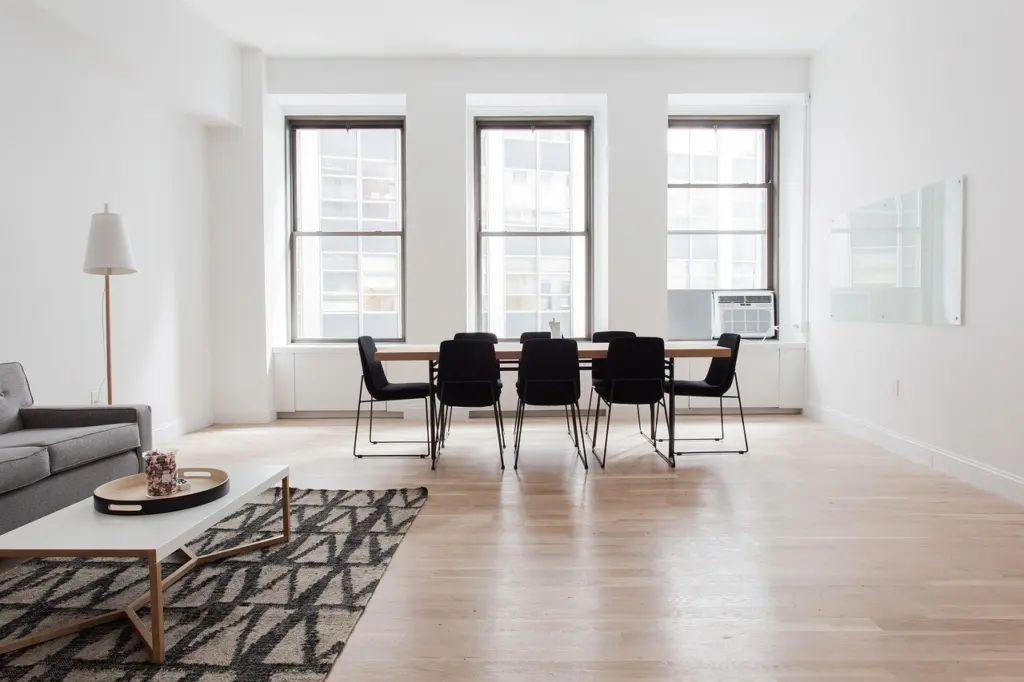
Design Cafe says balance can go three ways: symmetrical, asymmetrical or radial. Decorilla recommends playing with those layouts to find the one that looks most pleasing. Symmetry suits a room with a strong central feature and gives a formal, settled feel. Asymmetry suits irregular rooms because you balance a heavy item on one side with several lighter ones on the other. Radial arrangements organize furniture around a central point, such as a round table. Sketch at least a symmetrical and an asymmetrical version and compare them, since a quick test is cheaper than moving a sofa.
Scale: size relative to the room
Scale, in Design Cafe’s definition, is how the objects in your design look compared to the rest of the space. The practical warning from Decorilla is that oversized furniture can overwhelm a small room, while too-small pieces can look lost. The error runs in both directions, so do not assume that small furniture is always the safe choice for a compact room.
Painter’s tape before purchase
Decorilla’s advice is to use painter’s tape to outline a piece’s dimensions on the floor or wall before buying. Mark the footprint of the sofa or bed, walk around it, and check whether the room still feels usable. This is the cheapest scale test available, and it works for rugs, tables and wall art as well. If the taped shape makes a route awkward, change the plan, not the room.
Thirds and open space
Decorilla also suggests dividing the space into thirds, both vertically and horizontally, and dispersing critical pieces within those zones. This prevents everything from clustering on one wall or at one height. It is a guide, not a law; use it to spot an arrangement that feels lopsided, then adjust with the balance options above.
Rooms with their own rules
Living rooms usually need the most deliberate layout, because seating, a focal point and circulation compete; how to arrange living room furniture covers awkward room shapes. Bedrooms are mainly a scale problem, and how to decorate a small bedroom applies the oversized-furniture warning to a compact space.
Building a color palette
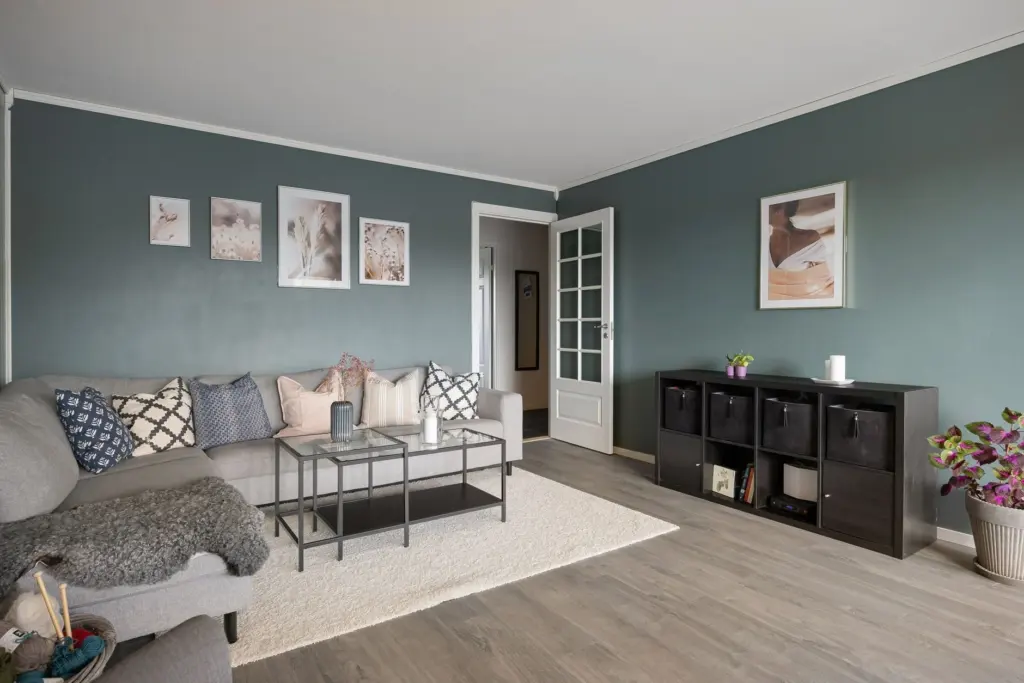
Choose a color palette by understanding the relationships between shades, then applying one consistent palette across the room. Decorilla advises focusing on those relationships, such as complementary or analogous pairings, and using a color wheel to find complementary colors for accents.
From base to accent
A reliable approach is to pick the dominant color first, usually the walls or the largest upholstered piece, then add accents drawn from a color wheel. Decorilla’s advice to start with a dominant pattern or texture as a base and layer complementary ones on top works the same way: one element leads, the others support. If you have already built a mood board, your recurring colors are the best candidates for the base.
Consistency over variety
Decorilla recommends a consistent color palette across different elements and textures. Design Cafe adds that colors, textures and materials together help achieve harmony. In practice this means a color should appear more than once: in a cushion, a rug and a piece of art, for instance. A single appearance reads as an accident, while repetition reads as a decision. Design Cafe describes this as simple repetition, repeating a color throughout the interiors of a place, and treats it as a way of creating rhythm.
Contrast in moderation
Contrast gives a room life, but Decorilla advises using contrasting elements in moderation to avoid overwhelming the space. A useful test: if you remove the strongest contrast and the room becomes dull, keep it small; if the room still works, the contrast is probably optional.
Finishing the surface
Once the color is chosen, the paint finish still matters for how it looks and wears. The paint sheen guide helps you match a finish to a room.
Lighting layers
Light a room in layers: ambient first, then task lighting for specific activities, and accent lighting last. Decorilla’s sequence is the simplest framework for beginners, and it is why lighting belongs in the plan from the start rather than being added at the end.
| Layer | Role in the sequence | Planning use |
|---|---|---|
| Ambient | The first layer, providing overall light for the room | Decide it first and put it on a dimmer switch so brightness can change with use |
| Task | Added next for specific activities | Place it where activities happen, such as reading, working or preparing food |
| Accent | Finishes the scheme | Point it at the focal point or at art, so the emphasis is reinforced |
The sequence and the advice to incorporate dimmer switches for ambient lighting come from Decorilla’s interior design rules.
Using the layers
The order matters because each layer has a different job. Ambient lighting sets the baseline; if it is wrong, task and accent lights end up compensating for it. Dimmers give you control over the ambient layer, so one room can serve different moods and times of day. Matching accent lighting to the focal point links two earlier decisions: the thing you chose to emphasize is also the thing you light deliberately. For the technical side, the National Design Academy counts lighting among the core technical areas of interior design alongside space planning and traffic flow and colour theory and its psychology, a reminder that lighting deserves planning rather than afterthought bulbs.
Interior design styles and where to start
The main interior design styles are named looks that bundle color, materials and shapes, but you do not need to commit to one name to design well. Decorilla notes that interior design rules apply to any design style, so balance, scale, a focal point and layered lighting transfer whichever look you choose.
The Seattle Times guide also stresses that a skilled designer sees the big picture and can help build a cohesive look across color, style and materials. You can borrow the idea without hiring anyone: choose one style as the lead and let the others appear only as accents.
Style routes on this site
- Industrial: begin with What Is Industrial Interior Design? A Practical Guide To Lofty Style In 2026, then move to Modern Industrial Interior Design: How To Create Raw, Cozy, And Timeless Spaces In 2026 or the warmer Rustic Industrial Interior Design: How To Create Warm, Edgy Spaces In 2026.
- Calm and light: Japandi Style Living Room: How To Create A Calm, Cozy Space In 2026 suits readers who want restraint, and Warm Minimalist Living Room: How To Create A Cozy, Clutter‑Free Space In 2026 suits those who want a pared-back room that still feels welcoming.
- Dark and atmospheric: Cozy Moody Living Room: How To Craft Warm, Atmospheric Spaces In 2026 is for readers drawn to deep colors, and Modern Dark Academia Bedroom: How To Create a Moody, Timeless Sanctuary In 2026 carries that mood into a bedroom.
Choosing between them
Return to your mood board. If it is full of exposed materials and utilitarian shapes, the industrial route is the likely fit. If it shows pale surfaces and empty space, look at the calm routes. If your saved rooms are dark and layered, the moody routes will serve you better. Because the rules apply across styles, a wrong guess costs you less than you might fear: the layout, palette consistency and lighting work you have already done carry over.
Room-by-room planning
Each room applies the same basics with a different emphasis. Use the table of priorities below as a working order, then follow the linked guide for the room you are tackling.
Living room
The living room is where focal point and layout matter most, since seating has to face something and still allow conversation. Pick the focal point, outline the sofa with tape, then add rugs and lighting. The style guides for Cozy Moody Living Room: How To Craft Warm, Atmospheric Spaces In 2026, Japandi and warm minimalist rooms above show how that plan can look in different moods.
Bedroom
Scale is the main risk, particularly in a small bedroom. Check the footprint of the bed with tape before ordering, keep unoccupied areas so the room can breathe, and use dimmable ambient light with task lighting where you read.
Kitchen and workspace
Kitchens and workspaces lean on ergonomics and lifestyle: the plan has to support activity before it supports looks, which is where task lighting earns its place. If your taste runs industrial, Industrial-Style Kitchen: How To Create A Raw, Functional Space In 2026 and Industrial Office Interior Design: How To Create Functional, Stylish Workspaces In 2026 translate the look into working rooms.
When to work alone and when to get help
Work alone when the project is a single room, the budget is modest and you can follow the sequence above. Consider a professional when you struggle to keep color, style and materials cohesive across several rooms, because that big-picture view is what the Seattle Times guide credits to a skilled designer. A middle path is to complete your own mood board, palette and taped layout first, then show them to a designer: you will have specific preferences instead of a blank page, and the conversation becomes about refining a plan.
Whatever you decide, avoid rushing to buy. The consistent advice across these sources is to decide before purchasing: budget first, images early, layout tested, palette repeated. Beginners who follow that order usually avoid the largest and least reversible mistakes.
Frequently asked questions
| Question | Answer |
|---|---|
| Do design rules change with the style I choose? | No. Decorilla says interior design rules apply to any design style, so you can learn the basics once and reuse them for any look. |
| What should I do before buying a large piece of furniture? | Outline its dimensions with painter’s tape on the floor or wall, as Decorilla suggests, and check how the room feels around the taped shape. |
| Can a beginner redecorate their own home as practice? | Yes. The National Design Academy recommends treating your own home as a design challenge, provided you go through the full process rather than skipping stages. |
| Which lighting do I add first? | Ambient lighting, followed by task lighting for specific activities and then accent lighting; Decorilla also recommends dimmer switches for the ambient layer. |