| Cost signal | Supported figure | Planning use |
|---|---|---|
| National average per square foot, May 2026 | $5.40 to $10.79 per square foot | Measure the cabinet faces and use this range to sense-check a quote. |
| National average for a professional job, 2026 | Average $4,000; most projects $2,500 to $6,500 | Use as a starting budget for a pro. A quote far outside the range is a reason to ask what is included. |
| Kitchen size bands | Small $1,000 to $3,500; medium $3,500 to $7,000; large $5,000 to $10,000+ | Pick the band closest to your kitchen, then check it against your door and drawer count. |
| Labor and materials share of a pro job | Labor 65% to 75%; materials 10% to 15% | Labor is most of a professional bill, so it is where DIY saves the most. |
| Small DIY project | As low as $180 | Treat this as a floor for a small project, not a whole-kitchen figure. |
These figures come from Homewyse’s national cost estimate and Handvetted’s 2026 cost roundup, which cites Angi and Fixr.
How much does it cost to paint kitchen cabinets depends mostly on who does the labor. Handvetted puts the 2026 national average for a professional job at $4,000, while a small DIY project can cost as little as $180.
Where a cabinet repaint sits among the home improvement projects that add value depends on how much of the price is labor, so the sections below start with what professionals charge and then move to DIY and the mechanics behind both.
What professionals charge
A professional cabinet paint job is priced by the piece, by the kitchen, or by measured area, and the published figures overlap without matching. Compare any quote against more than one of these yardsticks.
Per door and drawer front
Per-piece pricing is the easiest way to see what a quote contains, because you can count the pieces yourself.
- Typical range: Elevated Magazines reports that professionals may charge about $75 to $175 per door or drawer front.
- Franchise pricing: Handvetted relays CertaPro’s statement that cabinet painting is typically priced at $125 to $185 per piece.
- Older benchmark: A 2018 contractor-estimating guide from Pittsburgh Spray Equipment gave $80 to $120 per opening, with doors at about $100 and drawers at about $80. These figures date from 2018.
Whole-kitchen bands
Handvetted also reports that kitchen guides commonly place 21 to 40 cabinet faces at about $5,000 to $7,000, and 40 or more at about $7,000 to $12,000. A large professionally painted kitchen can reach $3,200 in another figure it cites, and Angi’s reported average is $938, with a typical range of $425 to $1,463.
That spread is wide. A quote at either end of it deserves questions about how many pieces are included, how many coats are applied and how much prep is covered. Count your doors and drawer fronts before you call anyone, because every method above depends on that count.
Measured-area pricing
Handvetted notes kitchen guides at around $30 to $70 per linear foot or $3 to $10 per square foot. Homewyse’s May 2026 national average is $5.40 to $10.79 per square foot, a separate estimate. Measured-area pricing is handy for a first estimate but not for comparing bids, because it does not capture the detail work that a piece count does.
DIY costs and when painting yourself pays
DIY removes the largest line in a professional bill, which is labor. Handvetted cites the Angi cost guide for a small DIY cabinet project as low as $180, and materials usually make up only 10% to 15% of a professional total.
What the savings depend on
Handvetted is blunt about the trade-off: professional painters charge more because they bring process, equipment and repeatable results, and DIY is only smart when your tolerance for imperfections is high. Use that as the deciding test.
- Choose DIY when you accept hand-applied brush or roller texture, can work through the doors and drawer fronts without hurrying, and want to keep the budget close to the cost of materials.
- Choose a professional when you want a smooth, repeatable finish across the whole kitchen, or when the project involves laminate, thermofoil, color changes or new hardware holes, all covered below.
- Choose a split approach when the doors are the concern: a quote for the doors and drawer fronts alone can be compared with the cost of doing the cabinet boxes yourself.
The sprayer question
A sprayed finish changes the cost sheet for both routes. Homewyse’s labor and equipment assumptions include a 115 V high volume, low pressure sprayer on a daily rental for fine finish quality, so a DIY spray finish adds an equipment line that a brush-and-roller job lacks. Elevated Magazines adds that spraying may cost more because it requires a more involved process. If sanding is the step that worries you, How To Paint Kitchen Cabinets Without Sanding: A Simple 2026 Guide To Smooth, Long-Lasting Results shows a lower-effort route.
Hardware, primer and color choices
Three decisions made before painting start can change the final price more than the paint brand: what you do with hardware, which primer the surface needs, and how far the new color is from the old one.
- Hardware: Elevated Magazines notes that hardware changes can affect the price, particularly when existing holes must be filled and new ones drilled. Reusing the existing pulls in the existing holes avoids that work.
- Surface type: According to the same source, laminate and thermofoil need a specially selected primer, so confirm the primer before accepting a bid for those surfaces.
- Dark to light: Elevated Magazines also states that each additional coat increases material costs, labor and the drying time between coats. A big color change means more coats, which means more of all three.
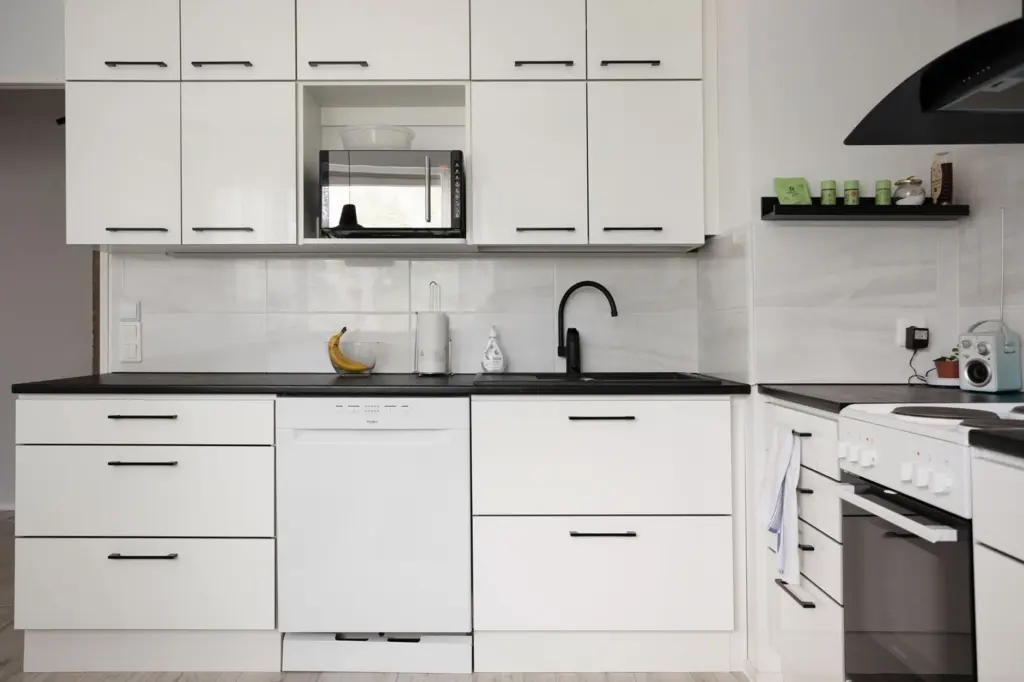
Where the money goes
Labor is the main cost in a professional job, which is why DIY savings are so large and why quotes vary so much between painters.
Labor versus materials
Elevated Magazines puts current industry estimates for labor at roughly 70% to 85% of the total project cost. Handvetted, citing Clear Home Projects, gives 65% to 75% for labor and 10% to 15% for materials. The two ranges differ, but both say paint and primer are a small slice of what a pro charges.
What the labor covers
Homewyse lists its basic labor assumptions, and they show how many steps stand between a bare cabinet and a finished one.
- Prep: up to 4 hr per 100 SF, including removing or masking hardware.
- Repairs: cleaning, scraping, sanding and repairing up to 4 minor defects per 100 SF.
- Finish: rolling or brushing 2 coats.
If a quote is lower than expected, check whether it covers every one of these steps, because labor hours left out of the quote usually come back later as extras.
Extras that can move a quote
Homewyse says to add 13% to 22% to the total if a general contractor will supervise the project. It also notes that costs can rise with schedule difficulty or during periods of local labor shortages. Decide early whether you need a supervised project or can book a painter directly.
One exclusion matters for older homes. Homewyse’s estimate does not include testing and remediation of hazardous materials such as asbestos, lead and radon. If a home’s age raises that concern, any such work would be separate from the painting figure.
Building your budget
Use these steps to put a DIY plan and a professional quote side by side.
- Count the pieces. Tally doors and drawer fronts, then note any laminate or thermofoil surfaces.
- Price the pro route. Compare the per-piece quote with the size band for your kitchen and with the national average, and confirm the number of coats and the primer.
- Price the DIY route. Start from the low-end DIY figure, then add primer, any sprayer rental and new hardware if you plan a layout change.
- Add the extras. Include supervision if you want it, plus any hole filling for new hardware.
- Decide on the finish you will accept. The gap between the two totals is the price of a smoother, repeatable finish.
If you are also refreshing a fireplace in the same project, How To Paint A Brick Fireplace (Step‑By‑Step Guide For A Fresh, Timeless Look) covers that job separately.
Frequently asked questions
How much does a pro charge to paint cabinets?
Handvetted reports a 2026 national average of $4,000, with most projects between $2,500 and $6,500. Per-piece rates reported elsewhere run from about $75 to $175 per door or drawer front.
What does DIY cost?
A small DIY cabinet project can be as low as $180 according to the Angi cost guide cited by Handvetted. A sprayer rental, primer for tricky surfaces and new hardware can raise that.
Is a per-linear-foot quote enough to compare bids?
Not on its own. Pittsburgh Spray Equipment’s estimating guide says the linear-foot method does not account for the masking work tied to the number of cabinet openings, so ask for a piece count as well.