Cast iron vs wrought iron appears in many buyer questions. The reader wants clear criteria. This article compares the two metals. It lists key differences and practical uses. It helps the reader pick metal for cookware, gates, tools, or structure. The text stays direct and factual. The reader will find actionable points and simple rules to decide.
Key Takeaways
- Cast iron contains higher carbon making it hard and brittle, ideal for cookware and heavy compression parts.
- Wrought iron has very low carbon with fibrous slag, offering ductility for decorative and flexible structural uses.
- Cast iron forms in molds and is cost-effective for mass production, while wrought iron is forged, costing more due to labor-intensive fabrication.
- Cast iron excels in wear resistance and even heat distribution, perfect for skillets and machine bases.
- Wrought iron withstands dynamic loads and repeated bending, making it suited for gates, railings, and artisan metalwork.
- Choosing between cast iron and wrought iron depends on application needs, cost considerations, and environmental factors like recycling and local sourcing.
Quick Side-By-Side Comparison: Key Differences At A Glance
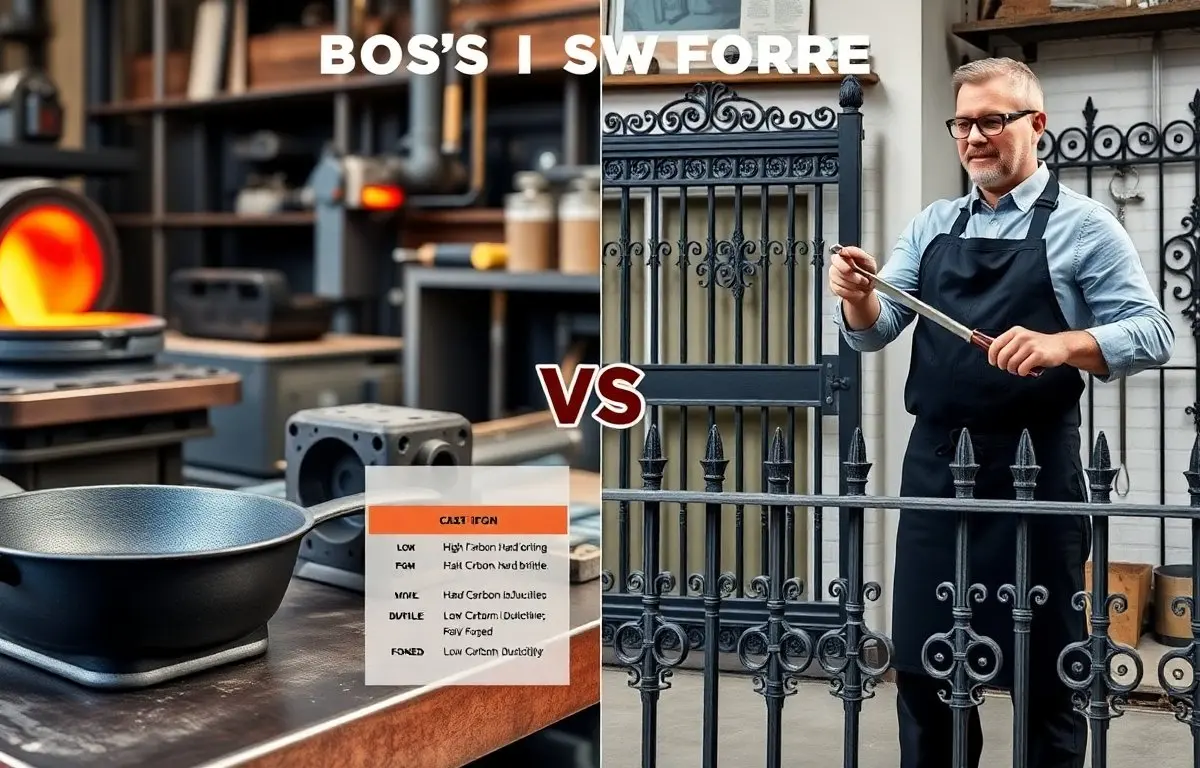
Cast iron vs wrought iron differ in composition, form, and use. Cast iron contains higher carbon and silicon. Wrought iron contains very low carbon and higher slag fibers. Cast iron forms in molds. Wrought iron forms by forging and drawing. Cast iron tends to be hard and brittle. Wrought iron tends to bend without breaking. Cast iron suits heavy compression parts and cookware. Wrought iron suits decorative work and parts that need ductility. Cast iron costs less per pound for raw castings. Wrought iron costs more because of labor and fabrication.
To pick quickly: choose cast iron when the priority is wear resistance, stiffness, dimensional repeatability, or thermal mass (for example, a skillet, machine base, or pipe). Choose wrought iron when the priority is toughness, weldability, or the ability to absorb shocks and repeated bending (for example, ornate railings, hand-forged gates, or restoration pieces).
- Visual and tactile cues: cast iron is usually dense, has a granular fracture surface, and will chip or crack if stressed sharply; wrought iron shows fibrous grain and bends rather than cleanly fracturing.
- Fabrication cue: if a part is cast from a mold it’s cast iron; if it’s individually forged or bent by a smith it’s wrought iron or mild steel made to similar appearance.
Origins, Composition, And Manufacturing Processes
Cast iron vs wrought iron trace to different historical uses. Cast iron entered industry after blast furnaces scaled in the 1700s. Wrought iron served builders and blacksmiths for centuries before that. Cast iron forms when molten iron cools in a mold. Wrought iron forms when smiths heat, fold, and hammer iron to remove impurities. Cast iron contains roughly 2–4% carbon. Wrought iron contains less than 0.08% carbon plus slag. Cast iron cooling forms graphite or cementite. Wrought iron retains fibrous slag that gives it a grain.
Manufacturing differences affect microstructure and performance. In castings, the cooling rate, mold material, and alloying elements influence whether graphite appears as flakes, nodules, or combined carbides. In wrought processing, repeated working and exposure to oxygen help separate and elongate slag inclusions, producing a fibrous structure that improves toughness and provides a characteristic “wrought” look.
Modern notes: true wrought iron is rare today; many projects specified as “wrought iron” use mild steel or fabricated steel finished to look like traditional wrought work. When authenticity matters (for restoration), confirm source and process rather than relying solely on appearance.
Mechanical Properties, Strength, And Durability
Cast iron vs wrought iron behave differently under load. Cast iron shows high compressive strength and good wear resistance. Wrought iron shows higher tensile strength per unit of ductility. Cast iron breaks suddenly under impact. Wrought iron yields and bends before fracture. Cast iron resists surface wear in bearings and engine blocks. Wrought iron resists dynamic loads in gates and railings. Cast iron performs well as a stiff base or cookware that spreads heat. Wrought iron performs well where repeated bending, hammering, or shaping occurs. Designers must match load type to the metal choice.
Practical implications for design and maintenance:
- Impact and shock: avoid using cast iron where sudden impacts or flexing are likely; wrought iron or modern steels are safer choices.
- Fatigue resistance: wrought iron’s ductility gives it an advantage under cyclic loads; cast iron can develop cracks that propagate quickly under repeated stress.
- Wear and hardness: cast iron’s hardness and graphite presence give excellent sliding wear resistance and self-lubricating properties in some bearings and sliding applications.
- Repair and joining: wrought iron or steel can be welded and forged; cast iron is more difficult to weld and often requires preheating, special electrodes, or mechanical fastening for reliable repair.
Common Modern Uses: From Cookware To Architecture
Cast iron vs wrought iron appear in distinct product groups today. Cast iron appears in skillets, engine blocks, pipes, and machine bases. Wrought iron appears in gates, railings, decorative grills, and historical restorations. Cast iron cookware gives even heat and long life when seasoned. Wrought iron work allows artisans to bend and twist detailed shapes. Cast iron appears where mass production and mold casting reduce cost. Wrought iron appears where handwork, welds, or visible craftsmanship add value. Buyers choose cast iron for heavy-duty heat or compressive parts. Buyers choose wrought iron for decorative or flexible structural needs.
Examples to help match application to material:
- Cookware: cast iron skillets retain heat and are forgiving for searing; wrought iron is not used for cookware.
- Architectural elements: decorative gates and historic trims are commonly wrought-style (forged or fabricated steel) for aesthetic and toughness reasons; cast decorative elements are used where repetition and low cost outweigh ductility needs.
- Industrial parts: engine blocks, pump housings, and heavy machine frames often use cast iron for rigidity and damping; components exposed to tensile shock or needing forging are made from wrought-like steels.
Cost, Availability, And Environmental Considerations
Cast iron vs wrought iron differ in cost and sourcing. Cast iron usually costs less for bulk parts and is widely available from foundries. Wrought iron, or its modern equivalent mild steel with wrought-like finishes, costs more because of labor. Cast iron foundries reuse scrap and lower energy per finished kilogram in large runs. Wrought iron fabrication consumes labor and often uses older scrap sources. Cast iron recycling streams exist for engine blocks and pipes. Wrought iron decorative work often relies on skilled craftsmen and smaller shops. Buyers should weigh upfront cost, life-cycle painting needs, and local recycling options when they choose between the two metals.
Environmental and procurement tips:
- Recycling: both materials are recyclable, but cast iron parts are commonly remelted in foundries; ensure local recycling centers accept heavy cast components.
- Longevity vs maintenance: a well-maintained cast iron skillet or painted wrought railing can last generations; consider maintenance schedules (seasoning, repainting) when comparing life-cycle cost.
- Substitutes and availability: where wrought iron is specified but unavailable, fabricated mild steel with appropriate finishes is an acceptable and often more available substitute—confirm mechanical requirements first.
Final simple rules to decide: if you need hardness, thermal mass, wear resistance, or economical repeatable shapes, favor cast iron. If you need ductility, toughness, ease of repair, or hand-forged appearance, favor wrought iron or wrought-style steel. When in doubt for structural safety, consult an engineer with load specifics and local material availability.